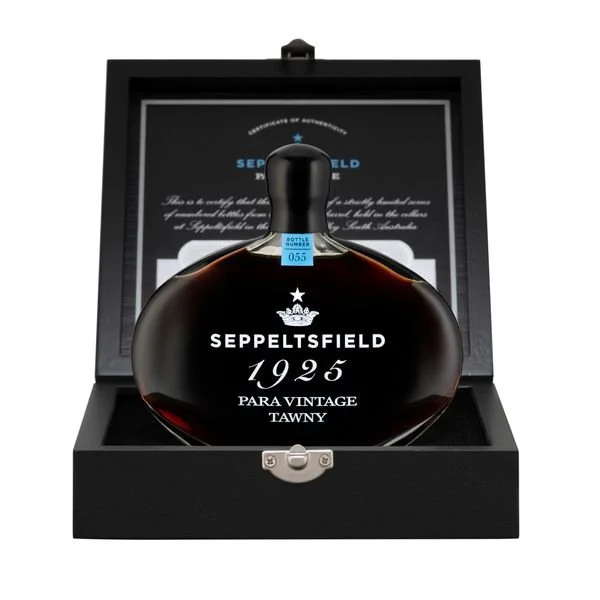
Seppeltsfield 1925 “100 Year Old” Para Vintage Tawny
Price: ¥180,000 (tax included ¥198,000)
Volume: 100ml | Closure: Cork
Varietal: Primarily Grenache & Shiraz (exact blend unknown)
Region: Barossa, South Australia
Alcohol: 23.1%
ALL VINTAGES AVAILABLE, PLEASE INQUIRE!!
Parker Reveiw
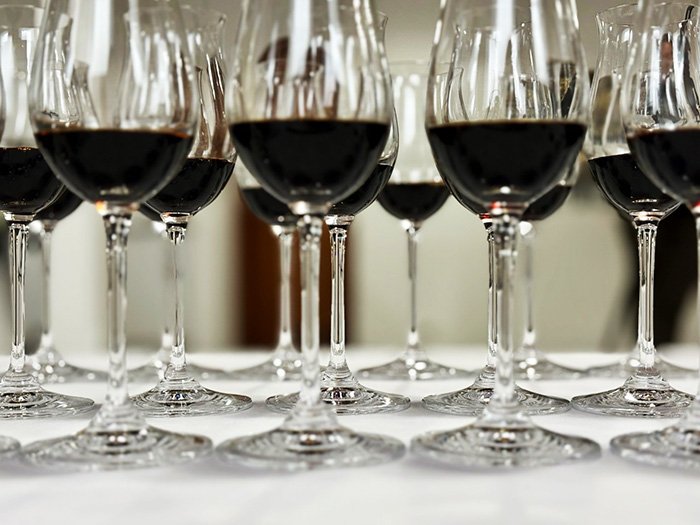
As we walked into the room beneath the Seppeltsfield winery in the Barossa, in September 2025, it was to take part in something hitherto not offered in Australian wine ever before: a full vertical of the Seppeltsfield Para Vintage Tawny, from 1878 through to 2016, to celebrate the estate's 175th anniversary. This is one of the only wines in the world to be released at 100 years of age. I’m not even sure that any other Australian winery would have the ability, the extensive museum, to offer a full vertical—with no vintages missing—that spans three centuries.
In the room, along with a select group of global press, was the current Seppeltsfield winemaking team, led by chief winemaker Fiona Donald and ably assisted in this endeavor by James Godfrey, who worked his way up to chief winemaker at Seppeltsfield from 1978–2007. It was he who piloted the Para Tawny program and elected to release the wines at 100 years of age, hence the opening vintage of 1878.
Despite their age, the wines displayed different characters from glass to glass. After tasting through the first, very small bracket of 1926–1921, it was already clear that the wines were to be divided into two camps: texture and flavor.
Texture
The texture component played a far bigger role in my enjoyment of the wines than I initially anticipated. My scores in the ensuing tasting notes reflect this. There were some vintages, with 1904 as an excellent example, whereby I felt the texture was too thick, and this dragged the score down, although my perception of the complexity of the wine remained unperturbed and was recorded in the note. It resembles that of a sauce, rather than a beverage. In other instances, such as 1901, the texture was far thinner—more liquid, runnier—and this enhanced the overall experience. It turns out there is a reason for this difference in texture: racking. Most vintages are still in barrel and on the lees, even after more than a century. There are some that have been "enthusiastically sampled" over the years—1901 (Australia’s federation year) has been handled as such—and so the decision has been made to rack the wine and store it in glass. This arrests further development of the wine and sends its evolution on a slightly different and more savory tangent. It is true that the wines left on the lees are "fresher," however I discovered I’d happily sacrifice the freshness for the texture.
FLAVOR
The other crucial element to the wine is the flavor. This is impacted by a number of factors, even after so long in barrel. Volatility plays an important part. Some of the vintages display as quite volatile, with numbers up around 1.5 grams per liter; according to the AWRI (Australian Wine Research Institute), the sensory detection threshold is 0.6 to 0.9 grams per liter. The alcohol levels are quite different from vintage to vintage, and this impacts their perceived structure. Acidity is high, and this is vital in the wine appearing fresh and nimble. The balance between acidity, alcohol and sugar is central to understanding these wines and how their components integrate with one another. Some vintages are extremely sweet, while others present a comparatively restrained level of sweetness, one that is tempered by higher tannin or evident oak. The question of fruit expression also arises (is it even relevant in a wine that's over a century old?), as the aromatic and flavor spectrum can vary considerably. In some vintages, the profile may lean toward savory or umami notes—reminiscent of hoisin sauce—while others evoke characters of Christmas cake, cedar or walnut liqueur. Many of these nuances originate in the way the wines were produced in the first instance.
Maintenance
Equally important is the manner in which they are subsequently matured. These wines are typically stored in barrel, which becomes their final resting place during maturation. Alongside these barrels, winemakers maintain separate stocks of current (or other) vintage wine used for topping up. The frequency of topping up has a significant influence on the wine’s development. Barrels that are topped regularly—perhaps every two, three, four or five years—evolve very differently from those that are left without topping up for extended periods. If a barrel is not topped up for a decade, for example, the liquid level will drop and evaporation will be greater, resulting in a different oxidative trajectory. Another factor to consider is where the topping wine itself has been stored. In some cases, it remains in the regular cellar environment, where its position—whether on the top or bottom rows of the cellar—can subtly influence its aging and, consequently, the character of the wine used for topping up.
These wines are the result of multigenerational care. Over time, responsibility for them passes through several custodians so that the role becomes less that of a conventional winemaker and more that of a caretaker. The emphasis shifts from active winemaking to stewardship, with the wines managed through a long-term maintenance program rather than a traditional production-focused approach.
As the wines age, their volume gradually diminishes. A barrel that may have once held 2,500 liters can ultimately yield as little as 400 liters after years of topping up, evaporation, sampling and final racking. Throughout this process, the flavors and structural elements within the wine become progressively condensed and concentrated.
It is also worth noting that some vintages have been sampled more enthusiastically than others, a la the aforementioned 1901, which further contributes to the reduction in volume over time.
All of this was going through my mind before we commenced tasting and during the tasting. In the end, it was clear that all of this played a role in the wines, and each vintage really was distinct from its peers. I recorded significant historical events in each tasting note to give the tasting some context.
100 Point VintageS Seppeltsfield Centennial Collection Para Vintage Tawny
1878
The 1878 Centennial Collection Para Vintage Tawny is the first vintage of this wine ever produced. It’s the cornerstone of this winery. They laid down a barrel of their best port, and it wasn’t to be released for 100 years. Construction of the distillery was finished the year prior. The spirit will have been made with the Doradillo variety. It was made in a small pot still. Low strength. There are only 16 liters remaining of this wine. It is the first vintage that went into glass. The wine is balanced and spicy, profoundly complex and evocative, in a way that many of these wines before it have set out to be. The spirit is soft and perfectly integrated. Every aspect of this wine is seamless. Perhaps it is the weight of history here, or perhaps it is the fact that this is indeed the very best selection of "port" ever put aside here. It has sweet tobacco and pipe resin, dark chocolate, tapenade, burnt caramel and licorice. It’s too simplistic to say that this is what I taste, because the characters don’t capture the sheer intensity of the layering of all aspects over one another. It's a moving wine, one that has found complete harmony and balance. Glass. In 1878, Thomas Edison patents the phonograph.
1881
Light in color—in fact, a clear burnt-amber—the 1881 Centennial Collection Para Vintage Tawny is a spicy, lean wine that is slightly drying, in its way, and layered with star anise and clove, burnt sugar and aged leather, old books, medicinal herbs and a dryness akin to what you might find in a summer field. There is also bay leaf and a subtle turpentine lift. I like the warmth of alcohol through the finish—it is like drinking elegant, old Armagnac. This is a reflective, dappled wine of immense complexity. (To criticize, or to provide context to the room, the alcohol is pronounced, and it warms the cockles, perhaps in a way that feels unbalanced. Other tasters here today have loved this wine, with comments around this wine being akin to Cognac and Armagnac, even Calvados.) Glass. In 1881, Pablo Picasso is born.
1889 (In Stock)
The 1889 Centennial Collection Para Vintage Tawny appears light in the glass, and texturally, it is silky and fine. In the mouth, the wine is layered with leather and clove, civet paste and dark chocolate, arnica and rising tones of camphor woven through the finish. While the wine is wide and opulent (thick and mouth-coating), it has a vertical lift of volatile acidity that provides reprieve, and the savory, umami-like flavors provide a counterpoint to this as well. Delicately included here are rose petals, arnica, ship's sail, kelp and delicate notes of timut pepper, in the way that timut pepper can be laden with yellow grapefruit, fresh black tea, sage, resin, pink grapefruit and simple/singular. In 1889, the Eiffel Tower opens in Paris.
1899
Heading into tasting the wines from the 1800s, starting with this vintage, was exciting. It brought back memories as a kid, being on an amusement park ride, strapped in and heading into a dark tunnel. There's adrenaline and there's anticipation. The 1899 Centennial Collection Para Vintage Tawny is salty and nutty, with gingernut biscuit (gingersnap cookie), aged leather, black pepper, dark chocolate and tapenade. This is a kaleidoscopic wine, one that shows savory umami noes of nori, soy, kelp and even hung meat, alongside the sweeter, more unctuous characters of dark chocolate and the bitter sweetness of blackstrap molasses. It's unreal. In 1899, Charlie Chaplin is born
1906
The 1906 Centennial Collection Para Vintage Tawny leads with hung deli meat, roast ham, macerated cherries, coffee grounds, blackstrap molasses, pepper leaves and berries. In the mouth, the wine is pert and fresh; the core is a piercing rally cry to movement. This is a wine that penetrates and calls out, one that floats on a sea of viscosity, propelled by evident alcohol and structured by tannins that are so enveloped by the sugar that they seem almost invisible—and yet they balance, they shape. they coax. This is another outstanding wine, a monument. In 1906, SOS is adopted as the international distress signal.
1907
The 1907 Centennial Collection Para Vintage Tawny is almost thin in the glass compared to some of the vintages tasted around it, and in this way, it shows great delicacy and zip—if one could describe these wines as being possessed of zip. In the mouth, the wine is propelled by volatile acidity and alcohol, which cuts through any notion of sweetness and creates a wine of deep savory nuance. There are notes of black spice, leather, cardamom, clove, arnica and licorice, cedar, forest moss and ecclesiastical smoke. It has ethereal lift. To descend into memory to describe the objective observations of a wine is empirical, yet wines like this make it very difficult to remain purely objective. Occasionally, a wine will invoke noises and sounds, smells of holidays long since passed, people and emotions. This is the magic, the unpredictability and the subjectivity of these wines. Make of that what you will. 1907 is the year that Florence Nightingale became the first woman to receive the Order of Merit.
1922
The 1922 Centennial Collection Para Vintage Tawny leads with milk chocolate and cocoa, leather and vanilla pod. This has a cinnamon, Christmas cake, ginger and salted pistachio character, with stewed apple, amondine and campfire. It's not at all as smoky or savory as I remember it being upon tasting it the first time upon its release, but this is every bit as impactful. It's a beautiful wine with tendrils of flavor that curl through the memory like wisps of smoke from a blown candle. There is something magical and uncontrollable about this vintage, like the wisha-wisha-wisha of leaves in a redgum tree. 1922 is the year that the tomb of Tutankhamun was discovered in Egypt.
1925 (In Stock)
The 1925 Centennial Collection Para Vintage Tawny is smoky, savory and salty, with notes of tapenade, leather, cedar and brine. The wine itself is a distinctly savory rendition, quite distinct from the previous years tasted today. While the 1930 may prove to best it in this regard given time, this 1925 is a wine of earth, wood, flesh, timber, skin, spice and ash. 1925 was the year that F. Scott Fitzgerald published The Great Gatsby.
Halliday Wine Companion – 100 Points (Nick Ryan)
Inducted into the James Halliday Hall of Fame
Winemaking & Heritage
Seppeltsfield’s Centennial Collection is the only unbroken lineage of single-vintage Tawny in the world, dating back to 1878. The Centennial Cellar was established by Oscar “Benno” Seppelt, who set aside a puncheon of his finest wine each year with instructions that it would not be bottled until it reached 100 years of age.
The 1925 release is the 48th consecutive vintage from this historic cellar. Each year, select parcels of Grenache and Shiraz are fortified with brandy spirit and aged in old oak barrels. As the wine matures, it is transferred into progressively smaller barrels while approximately 3% evaporates annually as the “angel’s share,” concentrating flavor, aroma, and texture over a century.
Food Pairing
Pairs beautifully with:
60-month aged Parmigiano Reggiano
Dark chocolate desserts (e.g., Ferrero Rocher)
Roasted nuts or caramelized desserts
Additional Information
Style: 100-Year-Aged Vintage Tawny (Fortified Wine)
Serving Suggestion: Best served in a cognac-style glass
Recommended Pour: ~10ml
Presentation: Individually numbered bottle in a black wooden gift box with certificate 🍷